Friday, 13 January 2017

The glass is more than just half full in 2017

In January last year, I started this insight into my views with a posting titled ‘A new blog, for the New Year’. As we’re now knee deep in 2017, I’d like to begin this posting with the title ‘New opportunities for this New Year’.

As many of you will already be aware, I’m a person who’s glass is always half full. I believe that positivity in all we do helps to drive us forward, build aspiration and help us realise our goals. But I don’t think that I’m being unnecessarily optimistic when I say this year holds real promise for the FE sector at large, and also for East Kent College and Canterbury College.

But why this optimism, I hear you cry. After years of cuts as austerity budget after austerity budget have been levied upon the sector, it doesn’t necessarily seem rational to be so positive, surely? And yet I am, and this is why.

The FE sector is full of buoyancy. There’s little doubt that it’s a service built of passionate people, but just recently I’ve been seeing commitment, and drive within the sector, which are unparalleled. The manner in which so many within our sector leapt to its defence, in such a rational, analytical manner when we were attacked in a TES opinion piece for failing to help disadvantaged students, was truly heartening. And I’m seeing a greater drive to ensure no-one’s nicking our lunch, while as a sector we perform with greater professionalism than ever before. No-one could badge us as some kind of unloved Cinderella sector anymore.

I’m also seeing greater movements within our Government to help drive the skills agenda, and promote technical learning as a real option for our young people. There seems to be a greater commitment from our politicians to ensure that FE is no longer subject to the educational prejudices of the past; a realisation, if you will, that while the well-trod pathway through University is good, it simply isn’t the answer for everyone.

And of course, we’ve seen figures such as Sir Michael Wilshaw leaving office. Sir Michael never truly understood FE, and never seemed to care for it. His unrelenting attacks while in office were nothing but unhelpful, for a part of the educational framework which delivers so much, for so many students.

On a more local level, we’ve hit the ground running in 2017, working toward the proposed merger between East Kent College and Canterbury College. This will ensure that we are collectively delivering an immense range of opportunities for the 17,000 students who attend our colleges.


So set against that backdrop, why wouldn’t I be positive about what this year’s going to bring? We live in a land of opportunity in FE, and locally at our colleges. We live in a world where our passion, commitment and relentless drive to ensure the best outcome for our students, delivers us the opportunity to really change our communities for the better. And it is just this opportunity that I am seeing all around me in 2017. So happy New Year; I know it’s going to be a great one.

Thursday, 22 December 2016

The Christmas Pudding of Life, and Education as Flour

If life was a Christmas Pudding, then education would be the flour.

It’s not going to deliver a delicious festive treat all on its own, but combined with all the other ingredients, it becomes something meaningful and delicious.

The great Christmas Pudding of life

 An obscure thought, but one which I’d like to expand on briefly. I decided upon the analogy recently, when I was asked by the Dover Business Forum to help launch the new Future Skills for Dover report. You can see the report in full here, but at the time I recall thinking that while developing the necessary skills for an area’s future are deeply important, it takes more than just that to create a great place to live – a great community if you will.

So what are the other ingredients in this Christmas Pudding? There’s little doubt that they’re many and varied, but there are some key things which would go into it. In Dover’s case, many of these ingredients are already there – the infrastructure, for example, with strong transport links from the docks, and the M20. Housing too, is one of those big things, and Dover’s playing its part in developing for the future, with more housebuilding taking place there than any other district in Kent. Jobs are clearly an important part of the place-making pudding too. Dover’s economy is buoyant currently, with retail investment, and a number of large companies looking for further expansion. And then there are the social factors – the mix of people and their demographic segments, family units, political beliefs, and, of course education opportunities.

These different ingredients – alongside many others I’ve neglected to mention – bind to create our societies, and our communities. And it’s just these communities which our College seeks to improve – either through delivering the best, most relevant curriculum we can, or through developing all of our students in an holistic manner, to ensure they ‘buy in’ to their community.
STEM are key skills required in Dover's education mix right now

That’s the reason we took part in the Future Skills for Dover research; ensuring we are delivering the best possible curriculum, which meets the needs of the community, and local employers, makes what our College does – namely delivering education – more meaningful. It means that we are helping to develop the area’s community more, not just its peoples skills. It makes our brand of further education less one dimensional, helping to develop more than just an individual’s skillset.

And that’s essentially the mission for East Kent College; we are committed to developing the prosperity and well-being of the communities we serve.

So to return to my original analogy, in the great Christmas Pudding of life I firmly believe that education – and more specifically further education – has a key part to play. It’s about developing the place, not just the people, and delivering a great community. I’m glad that our College has the strong local partners, and the vision, to ensure that we’re doing all we can to achieve this in the future.

Friday, 28 October 2016

Keeping promises and taking on challenges

Let me make something clear; I’m not a runner. I love my team sports, and I’m a committed and enthusiastic cricket player for my local side, but I’ve never been described as a runner of any sort. 

Despite that, I do stick to my promises, and I made a very important one in 2015, to a very important student. I’ve blogged about Emily Mackay before, so if you don’t know her story, take a look here

Needless to say, for those who knew her, Emily was an inspiration. She was heroic in her fight against cancer, and when I was lucky enough to present her with the Principal’s Award for Excellence at our 2015 Student Awards, I made the promise to her I would run the London Marathon for the charity she cared passionately about, the Teenage Cancer Trust.

Emily on the night I made my promise to her
The charity which Emily cared so much about is truly an excellent one. It actively supports all those aged between 13 and 24-years-old who have been diagnosed with cancer – that’s around seven per day. And it’s the only charity which has been specifically set up to support these young people. I know that the Teenage Cancer Trust helped Emily in her fight against cancer, and now I would like to help them continue to make a difference.
Emily was passionate about supporting the Teenage Cancer Trust
After Emily lost her battle with cancer in June, I resolved to make good on my promise to her. So earlier this year, I applied for a place to run the 2017 marathon on behalf of the Teenage Cancer Trust. I found out that I had been successful in my application, and would be taking part in 2017’s London Marathon.

And so I come to that initial statement I made; I am no runner but this year, I will be running. I’ve begun my training regime, created my sponsorship page, and have set my goals. And though I’m under no illusions that it’s going to be easy, I’ll be running for Emily, because she – despite her young age – was an absolute inspiration to me, and all of those around our whole College community. It is because I am #inspiredbyEmily, that I know I will make it around the marathon, and despite the fact it’ll be tough, I’ll be spurred on by her memory.

If you’d like to donate, please see my Virgin Money Giving fundraising page here . I’ll be using the hashtag #inspiredbyEmily throughout my journey, and would love it if you can tweet your support using this. 

Wednesday, 12 October 2016

Keeping it local for the best results

We’re going full circle. Before the industrial revolution, the vast majority of the country lived where they had grown up for their whole lives, never moving away from their childhood towns and villages. There was a greater focus on community, with the prevailing ideology of building a life in one place.

But that provincial lifestyle changed dramatically after industrialisation, with jobs drawing people from the shires into larger urban enclaves. Instead of the local farmer, baker, or indeed candlestick maker, being the primary source for produce, society began manufacturing in larger batches. It moved away from artisanal tradecraft, in favour of scaling industries to create efficiencies. This, it must be said, served the country relatively well for a period, with huge advances in technology, as well as rising standards of living for many.

But it was far from a perfect way of doing things, and over the past decade or so, society has begun to beat a retreat from this style of living. Campaigns for locally sourced food are on the rise, with growth in the number of farmers markets, as well as organisations like Produced in Kent promoting smaller producers. And people’s lifestyle habits are also beginning to change to reflect this, with fewer choosing to relocate large distances to find work, preferring instead to get a job in their local communities.

But what exactly does all this have to do with the world of further education? It’s simple really; FE has, to one degree or another, been replicating this newfound desire for local. Our College works in partnership with all of our local councils, and many of the key employers in our campus areas.
We’ve worked hard to build strong partnerships with large economic bodies such as the South East Local Enterprise Partnership and other important groups in order to identify and isolate key skills gaps in the local, and regional economies that we work in. But above all, we’ve worked to ensure we are nimble in our curriculum offering.

We’re constantly striving to provide the right skills for our local communities; the skills which are needed by business in those areas. That work which we do, will enable our students – once they finish their learning – to move more fluidly from the College, and into the wider world of work. It boosts their employability if we’re able to give them the skills needed in their communities. And that in turn boosts our communities, while ensuring the best possible outcomes for all of the College’s students.

We’ve worked hard to tailor our offering in each of our campuses, building close partnerships with employers, councils and a range of other groups. In Dover, we’ve seen work taking place on our engineering and hospitality offerings, as those are key sectors, while in Folkestone we’ve invested significant sums developing our construction trades and creative areas.

Why? Because those trades tally directly with what’s required in the district. Marrying our curriculum with local economic demand drives our students onto better progression, benefits their economy, and also delivers for the community.

It’s exactly that kind of holistic working which will ensure that further education – the engine of our economy – continues to deliver for everyone, far into the future.

Tuesday, 4 October 2016

Can I change your view on selective schooling?

The world of selective education has been on many people’s minds recently, following the revelation by Prime Minister Theresa May she would be actively looking to expand the system. It’s very much a polarising subject, with an equally long list of advocates and detractors.

And while a previous Labour Government attempted to do away with grammar schools, and the current Conservative Government favours an expansion of the system, it isn’t a purely party political issue. There are those Labour supporters who would favour their children going to a selective school, while there are Conservative voters who are utterly ambivalent about them.
Theresa May and education secretary Justine Greening Credit: Russell Watkins/Department for International Development
Whether or not the expansion of the grammar system is a sensible move or not is undoubtedly a tough nut to crack. As someone who received a secondary modern education, before going to University, you’d expect me to say that there’s fundamentally no need for selective education. But in some senses, you’d be wrong.

There is a strong case to be made for it, which – to one degree or another – hinges heavily on the results accrued by those with that grammar education. There’s no doubt that academic attainment is better in selective schools. With a whopping 94.8 per cent achieving five or more A* to C GCSEs, it’s clear there’s significant success. Contrast that with the secondary modern, which only manages a paltry 48.9 per cent of pupils achieving five or more A* to C GCSEs, and you’d think it was open and shut, and that expansion of this system should be pushed forward aggressively.

But then, to every Yin there tends to be a Yang. We are, after all, dealing with statistics – and as a mathematician at my core, I’m all too aware that you can present the same set of numbers in different ways. Obviously selective schools have the odds stacked in their favour for high academic achievement. After all, that’s how they choose their students to begin with; those who have the highest academic potential. But what happens when you look at the value added – performance after controlling for prior attainment – by the selective system?

Key stage 2 to Key Stage 4 students in selective schools managed to achieve a ‘value-added’ score of +24.8 according to a recent Government briefing paper. This means, that on average, these students achieved 0.5 grades higher in each of their eight GCSE subjects, than they otherwise would have.
To contrast that, for pupils at non-selective schools in partially-selective areas progress was slightly below average (- 1.6). That meant they achieved a quarter of a grade lower in one subject. But progress was lowest in non-selective schools in wholly-selective areas, such as the system we have in Kent. In these areas a score of -6.7 has meant pupils achieved on average one grade lower in one subject. This shows that there is indeed a limited amount of value added to those who make their way into a selective school, but, that it comes at a price.

And that price can be a steep one, particularly when you consider where the majority of students who attend comprehensive and secondary modern schools come from.

One of the primary reasons behind the Government’s promotion of the expansion of selective schools is social mobility. The theory is those from deprived backgrounds are able to rise up and achieve as a consequence of their raw natural talent due to the selective system. The problem with this argument is that fewer of those from deprived backgrounds ever actually manage to get to a grammar school.
Selective schools have markedly lower rates of deprived children, with a schools census by the Department for Education showing just 2.6 per cent receiving a free school meal. That contrasted directly with an average from all secondary schools which sat at 14.9 per cent. And it’s not just the free school meal statistics which show the typical grammar school’s pupil base. A report undertaken by the Sutton Trust in 2013 showed a large proportion of those at grammar schools had arrived there from independent preparatory schools. This serves to illustrate if a parent has some cash, they can essentially buy their child a place in a grammar school – not something which is an option for those from disadvantaged backgrounds. This all means that currently, those who are deprived remain at a disadvantage to those from more affluent backgrounds.

Another issue to consider when thinking about why selective schools manage to get much better academic achievements are the teachers. Selective schools have the most experienced staff by far, with 54 per cent of teachers at a grammar school boasting more than 10 years’ experience. Contrast that with secondary modern teachers, who have just 41 per cent of staff with that level of experience. It may go some way to explaining additional value which is added to those pupils who find themselves at a selective school.

As I said at the beginning of this piece, the selective debate is a matter of perspective, and one which transcends most boundaries. Many favour it, and many others abhor it, but one thing is certain; it is a deeply complex issue, which cannot look at achievement in isolation. There are a wide range of factors which feed into this debate, from deprivation, to teacher experience, and even armed with this knowledge it’s still not a simple decision. But though it isn’t easy, we will nonetheless need to make a decision to ensure the brightest and most positive future for all of our school children. Let’s all just hope the right one is made.

Wednesday, 14 September 2016

Efficient delivery and great building blocks

It’s a turbulent time in many sectors in our society. Following years of austerity, demographic change and other changes, many businesses and other organisations have moved to working more closely with one another. In my view, that makes sense. I have, in other blogs, spoken about my belief in the value of synchronicity and also about the importance of partnership working.

So when there were discussions for East Kent College and Canterbury College to build closer links – initially with our higher education delivery – it seemed like a very sensible idea to me. That happened back at the beginning of 2016, and since then our partnership has grown. The two distinct colleges now share an executive team and certain elements of our corporate services, creating leaner, more effective and efficient organisations. This enables us to deliver more, with less.

Canterbury College
And delivering more for less is one of the best ways to operate. That’s true not just for our colleges but also for our students. Tough funding environments and changes may act as a catalyst to this type of change, but ultimately it’s what we should all be aiming for anyway. It doesn’t matter whether we work in further education, or in any other sector; always striving for greater efficiency makes sense. When you look at the most successful businesses – the Apple’s and Google’s of this world – you can see quite clearly they’re always working to deliver more efficient models, with the most relevant products.

But a rise in efficiency doesn’t mean there should be any compromise in standards. Quality is still one of the fundamental building blocks of success for any organisation. Without a high quality product, no business will ever really be as successful as it could be. And a high quality technical and vocational education is something we’re working hard to maintain – and grow – with this partnership.

The partnership – in essence – is attempting to create a high quality product coupled with an efficient delivery. If we’re able to generate that, we’ll be aping a very successful business model indeed. And that, in a nutshell, is what we’re aiming to achieve with this partnership.

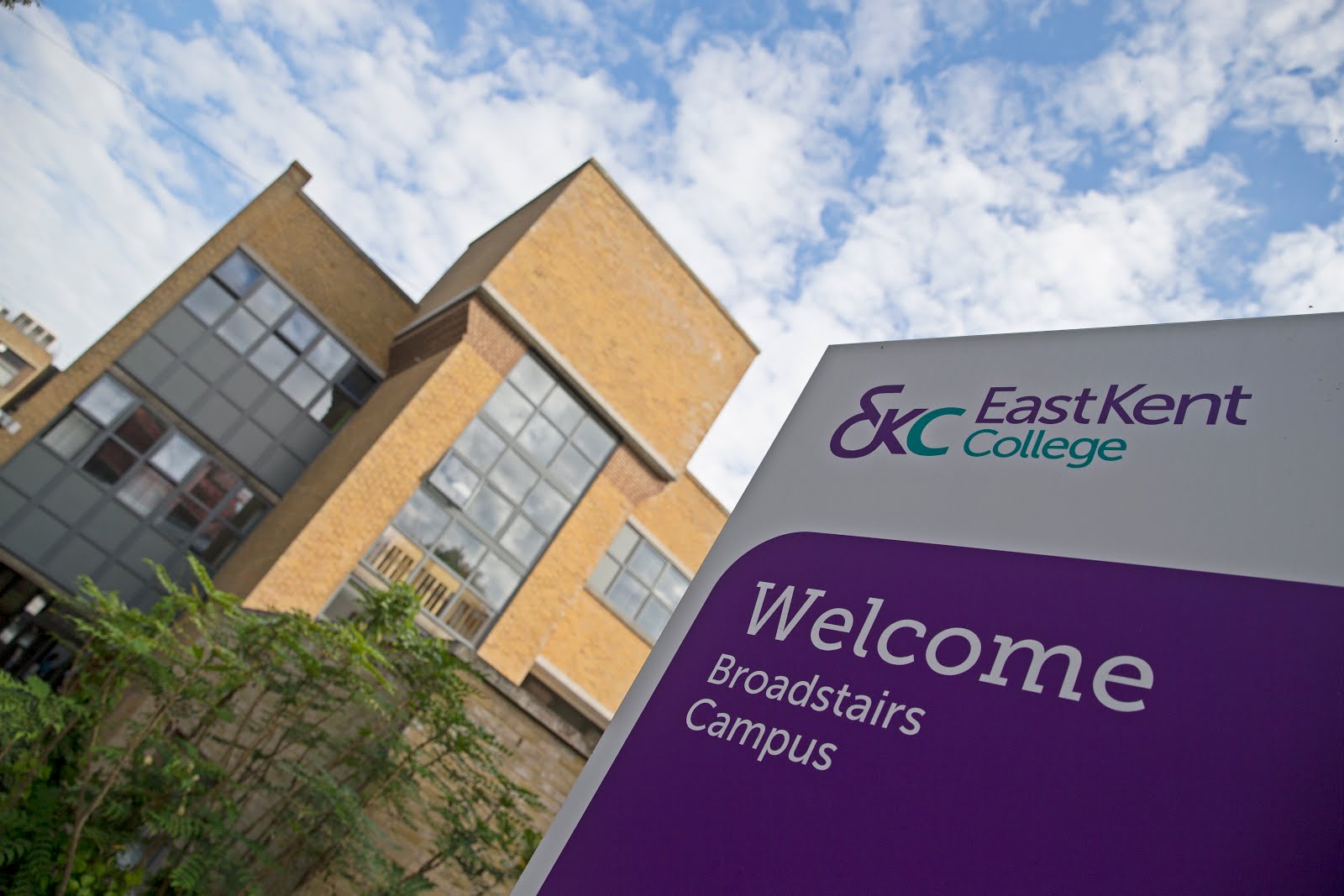
The Broadstairs Campus of East Kent College
So what has it delivered so far? It’s already brought savings, created significant efficiencies, and has helped us ensure that quality is delivered to a raised benchmark standard. It has meant that we’re able to use scale to ensure that we can provide our students – whether from Canterbury College or East Kent College – with the highest quality education, and the best possible outcomes.

And the future of this partnership is even more exciting. Why? Because as we move forward, we’ll be able to do more work in this realm, continuing to boost our students’ opportunities and outcomes while retaining vibrant and distinct further education offerings across the whole of east Kent.

Friday, 26 August 2016

It may be risky business but innovation shouldn’t be easy

Risk isn’t normally a word that you’d associate with the world of further education, but it is one you would associate with innovation.

I’ll make this clear right now; I have deep admiration for those who are willing to take risks in order to innovate. Whether that’s in the FE sector or elsewhere, pushing boundaries in order to build better outcomes is neither easy, nor always rewarding. But when it pays off, it can genuinely raise standards for whole sectors.

The world of FE does take risks, and of this I’m proud. I’ve been lucky enough to be surrounded by other sector leaders who’ve been brave enough to push forward and help innovate. But it’s not a simple process in this sector, and too often the consequences of failure may appear too great for an FE leader, to be worth taking the risk. After all, how many Principals have remained in post after suffering an inadequate rating by Ofsted? And how simple is it, in a sector with a tight funding regime to take a risk – however calculated – on something which might not work. I know first-hand that it isn’t easy, and I believe it can drive other FE leaders away from taking on the challenges of our sector through innovating. Sometimes though, an inadequate rating or wrestling with funding challenges have to be the price paid by those brave enough to be the first to do something.

I’m proud to say our College has taken risks throughout its history. There have been a number of risks – some which have paid off, and others which haven’t. Who, after all, could forget the time we opened a training centre at an airport which then promptly closed its runway for the last time. But that’s the struggle – we weren’t aware the airport was going to close at the time we started planning for the centre; in fact, all indications were that it would be successful, and there would be plenty of investment in the area. The positive thing was that the College was willing to take that risk in order to more closely marry our skills curriculum with what local business demands.

That failure highlights just how innovation isn’t always easy – after all, if it were, everybody would be doing it and it would cease to be innovative. Often it takes multiple attempts before there’s any success whatsoever, and there’s certainly never a guarantee that pioneering ideas will work out.
You also need to be clever about how you innovate in further education – there needs to be some degree of crystal ball gazing, and a genuine understanding of the communities you’re working in, and your local economy. Marrying skills delivery and local economies is never an easy task, but it’s an important one.
The Yarrow hotel is a risk, but will benefit students enormously 
We’ve recently taken a huge risk, opening the first ever training hotel which is owned and operated by a further education college. The Yarrow will provide a proving ground for our hospitality and catering programme areas, giving them the best possible experience to take out into the world of work. And I do believe that will marry with our local needs, situated as the hotel is in one of the country’s tourist hotspots, and a place where the local economy is crying out for skilled hospitality and catering employees. Despite those beliefs of mine, it is nonetheless a risk. If it pays off, it’ll be an incredible opportunity for our learners, as well as a real asset to the local economy, adding value to its current offer. And you know what; if it doesn’t succeed – and I truly don’t believe that will happen – we’ll pick ourselves up, and start work on our next innovation. That’s what this sector must be all about; continuing to strive for excellence.

Students will get to experience a vibrant, high quality live work environment, gaining new skills
The world of FE needs more people taking risks, and it needs more leaders willing to walk away from their comfort zone. We’re in a real period of rapid change, and if we are to truly make the progress which our students deserve, then leaders must continue delivering the innovation which will make further education the finest possible offer available.

So long live the pioneers, the innovators and those who are willing to take a risk in order to drive up standards, and drive forward further education, and I hope we see more of them as we all move forward together in this wonderful, vibrant sector.