Wednesday, 14 September 2016

Efficient delivery and great building blocks

It’s a turbulent time in many sectors in our society. Following years of austerity, demographic change and other changes, many businesses and other organisations have moved to working more closely with one another. In my view, that makes sense. I have, in other blogs, spoken about my belief in the value of synchronicity and also about the importance of partnership working.

So when there were discussions for East Kent College and Canterbury College to build closer links – initially with our higher education delivery – it seemed like a very sensible idea to me. That happened back at the beginning of 2016, and since then our partnership has grown. The two distinct colleges now share an executive team and certain elements of our corporate services, creating leaner, more effective and efficient organisations. This enables us to deliver more, with less.

Canterbury College
And delivering more for less is one of the best ways to operate. That’s true not just for our colleges but also for our students. Tough funding environments and changes may act as a catalyst to this type of change, but ultimately it’s what we should all be aiming for anyway. It doesn’t matter whether we work in further education, or in any other sector; always striving for greater efficiency makes sense. When you look at the most successful businesses – the Apple’s and Google’s of this world – you can see quite clearly they’re always working to deliver more efficient models, with the most relevant products.

But a rise in efficiency doesn’t mean there should be any compromise in standards. Quality is still one of the fundamental building blocks of success for any organisation. Without a high quality product, no business will ever really be as successful as it could be. And a high quality technical and vocational education is something we’re working hard to maintain – and grow – with this partnership.

The partnership – in essence – is attempting to create a high quality product coupled with an efficient delivery. If we’re able to generate that, we’ll be aping a very successful business model indeed. And that, in a nutshell, is what we’re aiming to achieve with this partnership.

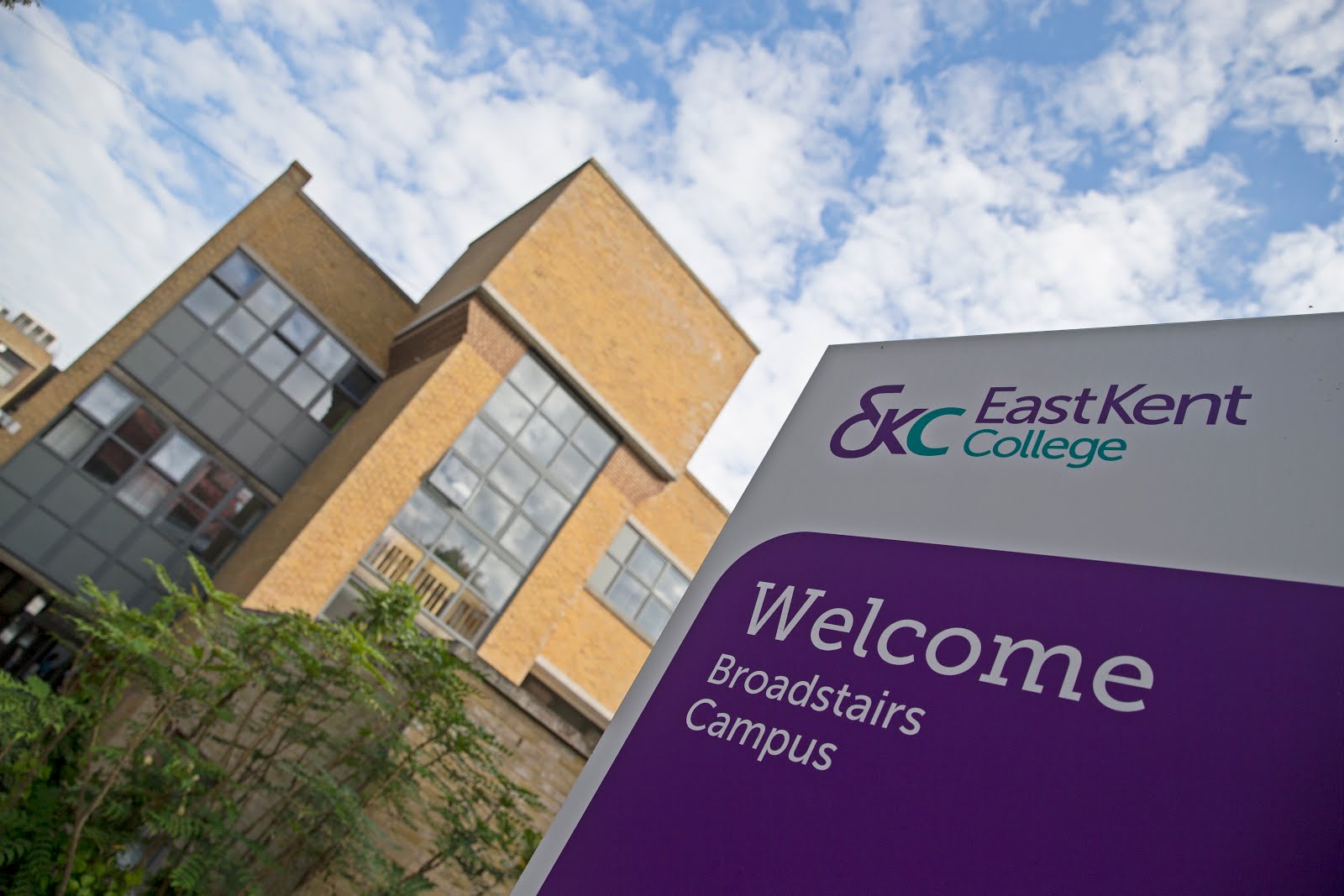
The Broadstairs Campus of East Kent College
So what has it delivered so far? It’s already brought savings, created significant efficiencies, and has helped us ensure that quality is delivered to a raised benchmark standard. It has meant that we’re able to use scale to ensure that we can provide our students – whether from Canterbury College or East Kent College – with the highest quality education, and the best possible outcomes.

And the future of this partnership is even more exciting. Why? Because as we move forward, we’ll be able to do more work in this realm, continuing to boost our students’ opportunities and outcomes while retaining vibrant and distinct further education offerings across the whole of east Kent.

Friday, 26 August 2016

It may be risky business but innovation shouldn’t be easy

Risk isn’t normally a word that you’d associate with the world of further education, but it is one you would associate with innovation.

I’ll make this clear right now; I have deep admiration for those who are willing to take risks in order to innovate. Whether that’s in the FE sector or elsewhere, pushing boundaries in order to build better outcomes is neither easy, nor always rewarding. But when it pays off, it can genuinely raise standards for whole sectors.

The world of FE does take risks, and of this I’m proud. I’ve been lucky enough to be surrounded by other sector leaders who’ve been brave enough to push forward and help innovate. But it’s not a simple process in this sector, and too often the consequences of failure may appear too great for an FE leader, to be worth taking the risk. After all, how many Principals have remained in post after suffering an inadequate rating by Ofsted? And how simple is it, in a sector with a tight funding regime to take a risk – however calculated – on something which might not work. I know first-hand that it isn’t easy, and I believe it can drive other FE leaders away from taking on the challenges of our sector through innovating. Sometimes though, an inadequate rating or wrestling with funding challenges have to be the price paid by those brave enough to be the first to do something.

I’m proud to say our College has taken risks throughout its history. There have been a number of risks – some which have paid off, and others which haven’t. Who, after all, could forget the time we opened a training centre at an airport which then promptly closed its runway for the last time. But that’s the struggle – we weren’t aware the airport was going to close at the time we started planning for the centre; in fact, all indications were that it would be successful, and there would be plenty of investment in the area. The positive thing was that the College was willing to take that risk in order to more closely marry our skills curriculum with what local business demands.

That failure highlights just how innovation isn’t always easy – after all, if it were, everybody would be doing it and it would cease to be innovative. Often it takes multiple attempts before there’s any success whatsoever, and there’s certainly never a guarantee that pioneering ideas will work out.
You also need to be clever about how you innovate in further education – there needs to be some degree of crystal ball gazing, and a genuine understanding of the communities you’re working in, and your local economy. Marrying skills delivery and local economies is never an easy task, but it’s an important one.
The Yarrow hotel is a risk, but will benefit students enormously 
We’ve recently taken a huge risk, opening the first ever training hotel which is owned and operated by a further education college. The Yarrow will provide a proving ground for our hospitality and catering programme areas, giving them the best possible experience to take out into the world of work. And I do believe that will marry with our local needs, situated as the hotel is in one of the country’s tourist hotspots, and a place where the local economy is crying out for skilled hospitality and catering employees. Despite those beliefs of mine, it is nonetheless a risk. If it pays off, it’ll be an incredible opportunity for our learners, as well as a real asset to the local economy, adding value to its current offer. And you know what; if it doesn’t succeed – and I truly don’t believe that will happen – we’ll pick ourselves up, and start work on our next innovation. That’s what this sector must be all about; continuing to strive for excellence.

Students will get to experience a vibrant, high quality live work environment, gaining new skills
The world of FE needs more people taking risks, and it needs more leaders willing to walk away from their comfort zone. We’re in a real period of rapid change, and if we are to truly make the progress which our students deserve, then leaders must continue delivering the innovation which will make further education the finest possible offer available.

So long live the pioneers, the innovators and those who are willing to take a risk in order to drive up standards, and drive forward further education, and I hope we see more of them as we all move forward together in this wonderful, vibrant sector.

Tuesday, 9 August 2016

Connections make the world go round....

I recently wrote a piece for the magazine published by the Kent branch of the Federation of Small Businesses. It was a piece about my belief in building partnerships and relationships with employers to ensure that our College delivers the skills wanted by employers and the local economy. 

For those of you who don't read the magazine, I've published the article in full here....

Connections are what make the world go round. From the personal to the professional, it’s the connections we build which help to define us. And in business there’s little difference, with many of the deals which are done, helped along by a professional’s network. 

We are building relationships with creative employers in Folkestone, helping deliver the skills required in the local economy
In the past links between business and education were clearly defined. For many years business worked in partnership with education providers, delivering high quality apprenticeships alongside institutions. That fell out of favour through the latter parts of the 20th Century, with many students taking a higher education pathway and getting a degree, as opposed to learning ‘on the job’ and gaining technical vocational skills.

That shift though, is now going full circle with a far greater emphasis being placed on real skills based learning. As a consequence, East Kent College has been working to build ever-stronger partnerships with many of the county’s major employers, while also identifying local skills needs. It’s certainly not easy to build a strategic partnership with a major employer, but they are far simpler to identify than the raft of small and medium sized businesses which make up the backbone of our economy. And in our communities, it is just those businesses which we need to begin engaging with in order to truly bridge the gap between industry and education. So I would ask you to consider what we can do to help your business, and what you could do to help a student into your industry. 

We are investing in our construction facilities to ensure we can help meet the skills shortage in the industry
If you’d like to find out more about building a partnership with East Kent College, get in touch with our business development team by calling 01843 605040

Friday, 22 July 2016

Doing the Ministerial shuffle


In the last few weeks, Britain’s political landscape has been shaken. The first big change was the EU Referendum result, with the subsequent resignation of David Cameron, the Conservative leadership race and finally the appointment of a new PM, alongside a team of new ministers.

As someone who’s always been proud to say they attended a comprehensive school, I felt that it was positive news the new Secretary of State heading up the Department for Education shared a similar educational background.

Justine Greening’s appointment to head up the department has doubtless come as further good news to those who attended a sixth form college, as she is well known for sitting her A Levels at one, before progressing on the well tread higher education pathway. This, it has been argued, will stand her in good stead as she moves into her new position. The chief executive of the AoC, Martin Doel, told TES that he was ‘pleased’ her good knowledge of the FE and skills sector as well as other college issues. The new Secretary of State herself also feels comfortable with FE, stating in the past that it was a ‘vital’ pathway for students, and also promoting her commitment to education as a tool for social mobility.

Justine Greening comes to the role from DFID Pic: https://www.flickr.com/photos/dfid/26580149602/

But she will undoubtedly face challenging times, as austerity endures and funding continues to dry up. There are also other big changes in her own department, which will undoubtedly cause fresh challenges, as the DfE takes on responsibility for further education policy, alongside apprenticeship and wider skills policy.

These changes make a lot of sense in my view, with the DfE able to act in a more strategically synchronised manner – a style of working I’ve previously advocated. Rather than the DfE’s responsibility for education automatically cutting off at age 18, the new changes will ensure that there is greater joined up thinking in order to ensure that students – whatever their age – are getting the best possible further education outcomes. And surely that’s good news.

This new style of working will also mean the incoming Apprentices and Skills Minister, Robert Halfon, gets the benefit of working in one department, rather than splitting his time between BIS and the DfE. And Mr Halfon will be bringing a solid knowledge of the FE and skills sector to the role, having had significant experience of it and as a leading Westminster champion for apprenticeships.


Robert Halfon is the new skills minister Pic: https://www.gov.uk/government/people/robert-halfon

So am I pleased with the changes at the Department for Education? While I’m certainly not disappointed by them, I think it’s really a question of waiting to see what happens as a consequence of the ministerial shuffle, as well as the departmental shuffle. I would like to think joining up the responsibilities of the new Apprentices and Skills Minister to have him working with one department will make education policy ever more robust for every learner, but as with most things in life, only time will really tell.

Regardless of what might happen in future, I would like to wish all of the new ministers a warm welcome, and say that I look forward to working with you to further our common goal of getting the best possible outcome for every student.

Monday, 18 July 2016

The importance of synchronicity in Further Education

Synchronicity. A simple word, but a tough concept to actually deliver. Nonetheless it’s a way of working which our College has tried to adopt in recent years, and we’re now beginning to see the fruit of our labours in a number of ways.

So what exactly do I mean by the word synchronicity in a further education context? For East Kent College it means working innovatively to deliver first class skills training, but also ticking other boxes at the same time; a holistic style of strategic planning which feeds down into our work at an operational level. Rather than simply providing the maximum number of courses, synchronicity ensures that the training is also in harmony with local needs. It means our staff working alongside business to ensure that skills gaps are filled through relevant training, resulting in better progression for our learners.

We have a couple of good examples of this behaviour in action recently. Working in partnership with Dover’s Marine Skills Academy – set up by the Viking group of companies – we’ve begun offering a marine engineering qualification from our campus in the town. It’s a good example of how we’ve looked to the local economy, identifying partners to highlight skills gaps in the area, before looking to deliver courses which help fill them.


We’re investing in areas which require better facilities to help deliver the skills the local economy needs too. Our construction area in Folkestone has recently received £1.48 million funding in order to expand its existing facility. This was based on the need for new skilled workers in the area, with the Construction Skills Network South East estimating that 970 more bricklayers alone will be required across the region by 2019.

Our employability area is also delivering results by working in partnership with local business. The team has begun a system of ‘sector based work academies’, which give their employability students intensive skills training for particular areas of the local economy in need of workers. Through the programme, they’ve managed a number of high profile placements, ensuring that students taking the programme are progressed into a suitable role which they are likely to stay in over the long term.

And of course, we have our new training hotel, The Yarrow. The College identified that there was a need for greater hospitality, and professional catering skills in the local area. With a buoyant tourism industry in Thanet, it made perfect sense to ensure our students were getting the high quality, real world commercial training required to be successful in this industry. The Yarrow helps ensure that we can deliver this for the local economy, and our local community.

But synchronicity isn’t simply about marrying education and the local economy. It’s also about ensuring the College, and its students are integrated into their community. I have already talked passionately about our community social action programmes in two of my blogs which I have linked here, so will instead highlight a couple of other instances of the College delivering for the community.

Ensuring that synchronicity is embedded in every aspect of the College, right down to the fabric of the buildings we develop, is core to the philosophy. One great example of this is the recent launch of our new Michael Wright Centre for the Creative Industries on the College’s Broadstairs Campus. A large new capital development project, from the very beginning our design brief required the architect ensure community functions could take place in the building. That was delivered, and we’ve already opened up the auditorium to local groups to use, with great success.


Our Edge creative agency in Folkestone has also worked to build links in the community. The town – which has a booming creative sector – has seen the area working hand in hand with the local newspaper, producing a range of high quality photojournalism which has been published regularly. It helps students build a professional portfolio, and network, while ensuring the local community is able to appreciate the work the College does. It also helps build the reputation of the students, and the wider work which is done on the campus, building the profile among stakeholders, the public and local businesses.

It is this type of holistic, synchronised further education provision which has helped the College embed itself into our communities, better the outcomes for our learners, and deliver the necessary skills for the local economy. It helps us make the most of every opportunity, and ticks all of the different boxes we want – as a whole College community – to deliver.

Friday, 13 May 2016

The importance of getting the basics right

Just a couple of weeks ago campaigners from a group called ‘Save our Early Years’ announced that there would soon be ‘catastrophic’ staff shortages in nurseries. Why this dire prediction for an entire industry – and one which is of critical importance? English and mathematics.

In September all nursery staff will be required to have at least Grade C GCSEs in these subjects, with Government deeming numeracy and literacy skills an essential component to work in this sector.

There is little doubt that these subjects are two of the most basic, and yet fundamental skills a person can have in our society. The importance of a good knowledge of both is clear. After all, English, both written and verbal, is critical to communicating successfully, and as a person who chose to train in maths, the importance of a decent understanding of its principles is all too clear to me.


You could say that these two areas of learning, above all others, are the building blocks for growing a person’s knowledge in other subjects. If a student is unable to communicate clearly and accurately, how can they progress their studies in other areas?

But despite that importance, there is a real struggle in FE to help our learners’ progress in both English and maths to Grade C at GCSE level. It isn’t a lack of desire on our part, nor is necessarily a lack of resources. Instead, it is a battle to inspire students who, having left school without the all-important Grade C, simply do not want to learn these key subjects.

And while there is – in my College, and many others – a real emphasis placed on the importance of learning these basic skills, improving results is neither easy, nor simple. Our maths and English tutors are being asked to achieve something in a mere 36 weeks which the pre-16 education system has failed to do after 11 years. And they are being asked to achieve this with the most challenging students; those who have already failed to achieve the required standard in these core subjects. That’s no criticism of the schools – rather the system itself – but it does place the issue into context, illustrating just how difficult it is for the FE sector to perform in this key test.


And yet FE is beginning to win the battle, with the Department for Education recently publishing a report (Level two and three attainment in England: Attainment by age 19 in 2015) which found that students achieving level two English and maths had risen from 67.8 per cent in 2014, to 70 per cent in 2015. Hardly meteoric, but it is definitely a step in the right direction.

And our college has also seen some successes, with good levels of achievement in a blended learning pilot we delivered last year. In fact, at East Kent College our students managed to achieve a fantastic 585 qualifications in English, and 588 qualifications in Maths. As a mathematician, it’ll come as little surprise that I’m particularly proud of our achievements in that subject, with a cross-campus rate of A* to C passes for 16-18 year olds at 31.8 per cent in 2014-15. During that academic year our Broadstairs Campus performed best, with a solid 37.2 per cent of all 16-18 year olds entered into GCSE maths getting the targeted A* to C grade. It’s also an area which Ofsted, at their recent visit to our Dover and Folkestone campuses flagged up, stating that “the focus on English and mathematics remains unrelenting, and the college’s determination to get this right is beyond reproach.” There is still more to do to meet the GCSE maths and English challenge, but FE – and East Kent College – is improving.

That’s good news for learners, for FE and for college principals across the country; but it’s not nearly good enough, and in fact a recent study of skills in England by the OECD has shown that the UK is still far below other countries in terms of numeracy and literacy. In fact, it sits very close to the bottom of a list with more students who’ve progressed to university with weak literacy and numeracy than most countries. And that’s the learners who have progressed to higher education – the story is worse between 16 and 19-year-old learners, with one third of them considered to have low basic skills.

So what now? What do we do as a sector to continue to grow these achievements? I suppose in many ways, we should treat maths and English studies as a bedrock to a student’s learning, because more than any other skills they may develop, these are the foundations for everything else. And our students can’t just be expected to learn these skills in a subject specific vacuum. Instead, we need to embed this core learning into everything we, as a sector do with our students. In order to grow their skills in their chosen areas, we need to ensure that high quality maths and English learning is emerging in all of their study. That means if we have a student on a professional catering course, tutors need to build functional maths and English skills into their everyday learning.

The challenge though, becomes even deeper when – as is the case for East Kent College – the areas in which it is located are economically deprived. Much of a student’s educational results are dependent on parental background, with those from disadvantaged areas less likely to achieve a high standard in core skills like maths and English. In constituencies with high levels of deprivation, the challenge to teach these skills to the required level becomes even greater. There is as yet, no clear solution to creating equity with more affluent areas in this respect, and that will continue to make the teaching of these core skills more challenging for colleges such as my own. Despite that, I’m proud to say that our commitment to promoting these basic skills is unwavering, and in fact has never been stronger than it is right now.

Thursday, 12 May 2016

Investing in the future of our creative sector

As a College which is passionate about ensuring our students have the best possible outcomes, we have worked hard over the past few years to ensure the courses we offer mirror the opportunities available in our local economies.

One of the fastest growing sectors in Thanet over the past few years has been the creative one. It has seen wide scale growth as cash has poured into regenerating Margate, first with the Turner Contemporary and then with Margate’s Old Town. The sector has also grown more broadly across Kent, providing almost 14,000 high quality jobs for those with the right skills.

This week East Kent College officially launched its Michael Wright Centre for the Creative Industries. The entire building is dedicated to ensuring that our students who want to break into this competitive sector have the finest facilities available to them. Ensuring they already have experience of working with industry standard equipment is of real importance if they are going to be able to move from our College straight into this exciting sector.
It was also a wonderful opportunity for me to meet up with the former Chair of our Governing body, and the man who the building was named after, Professor Michael Wright CBE DL.

L-R Graham Razey, Lucy McLeod, and Michael Wright
Michael was the man at the helm of East Kent College when I joined, so effectively became my boss and line manager. He became a real mentor to me, showing me the value of taking control and standing behind my decisions. I was proud to see our new building bear his name, as a legacy of his time working with East Kent College and promoting the cause of further education. It was his vision which saw the creative sector as a key area to expand into, in order to ensure the best opportunities for the young people who study with us.

When the building was conceived by Michael and other senior members of the College, the hope was that it would become a centre of excellence for the creative industries, with the highest specification equipment. That dream has been realised, with state-of-the-art technology embedded throughout the building, ensuring students are able to get the best opportunity to learn, create and build their skills. A large auditorium, digital media suite with the latest in computing technology, and large music performance spaces all mean staff and students are given the best opportunities to teach and learn.
Michael Wright sees students using the Mac Lab
These features also mean that the building is able to serve as a venue for community use, with the Principal of our Broadstairs Campus, Lucy McLeod, highlighting this as being one of the key uses for the auditorium. It has already held a talk about the history of the E-Type Jaguar, with a leading expert discussing the history of the company, and there are plans afoot to create a community choral society as well.

It’s a building which ticks all of the boxes, with our local economy, community and education all playing their part in its creation.