Wednesday, 10 October 2018

Let’s demand an Ace of Cost Base


We all talk about income in education. Income, income, income. That’s all I hear. And there’s a good reason for that. There’s no doubt that in education, as in all public sector organisations, Government doesn’t want any public perception of fat cat principals, or directors of training providers with huge bonuses. So income it is. But thinking about nothing more than income often leads education providers to debate the wrong topics. Let me explain what I mean.
No fatcats here - just a very large fish!
With that in mind, rather than discussing what impact dropping funding rates will have, it would be better for all providers to have a clear idea of the expected cost base of delivering an Apprenticeship. That would enable providers to understand the potential margin available for each framework, building in the ability of providers to budget for investment. Because that’s what we’re here for – to deliver high quality education and to develop the best offer which meets and serves our community’s needs.  And to do that, we need to understand the margins available.
Let's learn from business and think in margin and cost base terms - not just income!
At the moment, there’s a debate raging around income for different Apprenticeship frameworks. In fact, I recently spoke on a panel at an Apprenticeship conference, and one of the questions I faced was ‘what effect does reducing funding rates have on quality?’ In my view that’s the wrong question to be asking. We should really be asking what an acceptable margin is. But we can’t. And we can’t ask that for a couple of key reasons. The first of these is that clearly the concept of margin – or profit – for an educational provider is unacceptable. Why? Well, clearly we aren’t profit making institutions, so raking in huge sums wouldn’t be appropriate. What is appropriate is that we’re able to deliver a high quality education, while also achieving enough income to top slice an acceptable margin that will allow us to cover our fixed overheads and to invest in the organisation’s human and physical resources.
If we think in margin terms, we can reinvest that in our learning environments, such as our recently launched Construction Extension - that'll then help develop even more students!

The second reason we’re unable to answer the question of what margin is acceptable, is that we simply don’t know the answer. Yes, I hear you cry, we do. Well, we should, because hopefully the Institute for Apprenticeships is looking into the cost base of each framework, and then feeding that information into the sector. But they aren’t. Or at least, if they are, they certainly aren’t letting the sector know.


So we have a two pronged problems. We don’t know what the margin is, and worse than that, we can’t even really talk about margin. I think things need to change. Ultimately all education providers have the same goals to enhance and serve their community. We can only do that, if, like business, we examine the opportunity to grow and develop our own offer. And we’ll never be able to do this until we start speaking openly and honestly about the margin we all need to do that. 

So let’s stop just thinking about income, and let’s start demanding action to understand the true cost base of each Apprenticeship framework, so that we can start understanding the potential margins that we can reinvest for them.

Monday, 9 July 2018

Sometimes ‘fast fashion’ is a false economy


Stack products high and sell them cheap. It’s the mantra of many of our profit making companies, and there’s little doubt it’s been successful. In fact, it’s one of the facets that’s led to the decline of independent shops and boutiques on our high streets. Instead, we move in ‘fast fashion’ times, where shops’ supply chains allow them to develop a new product, and have them on the shelf weeks – if not days – later. But while it works for some things, all that pace isn’t right for every product. And so it is with an Apprenticeship – fast, stacked high, sold cheap Apprenticeships don’t work. In fact, I’d go farther than that, and suggest they have the potential to do real damage.
There’s no doubt that there’s a cloud hanging over Apprenticeships right now, with seemingly endless negative statistical releases, and the subsequent gloomy headlines that accompany them. From the employers which have used a meagre 10 per cent of their Apprenticeship levy funds in the first year of it, to the NHS’ decreased Apprenticeship starts, it seems to be a sea of bad news stories for something which should be transformational. In fact, it’s so gloomy in the world of Apprenticeships right now, with a year on year drop in starts of around 28 per cent, that there’s something quite seductive about the idea of just generating the numbers to fight the negative messages in the marketplace. But no matter how much we might like to do so, as a sector we need to resist this pressure to jump on the ‘fast fashion’ bandwagon of knocking out as many Apprenticeships as we can.

As a College Group which has grown significantly over the past eight years we have always been wedded to one key truth; that for us to be successful, we need to serve our communities, adding value to them as a whole. In fact, it’s such an important tenet of what we do, that it’s at the heart of our mission statement. And in order to really add value, and ensure that the communities we serve get maximum benefit, stacking education high, and selling it cheap is the antithesis of what we aspire to.

That philosophy also needs to apply to those employers who are looking for an apprentice too. It’s about making an investment in the future of the company, and by default the community in which they’re based. Ensuring the Apprentice receives their 20 per cent of off the job training time, and employers are paying their fees are key. Why? Because it develops the buy in which is necessary to make sure that the Apprentice is nurtured in their role, and given the tools they need to succeed. And if that Apprentice succeeds because they’ve had the best experience possible, then they’ll add many times that initial cost back into society – and the employer – through the skills they’ve developed. While it’s easy to hark back to a ‘golden era’ of Apprenticeships, lamenting the forgotten principles of tradecraft, it’s important not to do so too often. That’s because we have moved on. However, the core of an Apprenticeship should remain the same; namely that it’s not a numbers game, it’s a skills game – if we “stack ‘em high, and sell ‘em cheap” we do a disservice not just to our Apprentices, but also to society when their impact isn’t as great as it could be. And for educationalists, ensuring that we serve our learners and our communities, and therefore society, should really be at the heart of everything we do. If it isn’t, surely we need to reflect on why that is, and whether we should still be in this sector?


Tuesday, 1 May 2018

Let’s all give 100 per cent to build our society

What's the purpose of your college? Is it to simply churn out a generation of automatons, equipped with the skills to ply their trade, but not much more? I ask, because of the noisy criticism recently from a number of quarters, regarding the 20 per cent off the job training rule for apprentices.

There’s little doubt the apprentices we train within our Group are growing many more skills as a consequence of the 20 per cent off the job training they receive.

Off the job training gives apprentices the opportunity to learn even more new skills
But perhaps the issue is about something even more important than the huge range of soft skills students pick up.

In fact, I believe it’s about the future prosperity of UK PLC, and can there, really, be a bigger reason to embrace this rule than that?

In training new apprentices, we're growing the skills not just for an individual, or a business, or a community. We are developing those skills for our country’s long term prosperity. What do I mean by that? Well, in order to develop rounded workers, who can remain agile in a busy and dynamic employment market, and therefore help contribute to the wider growth of our society, we need skilled young people who understand the different ways of doing things. They need to be rounded, without organisational indoctrination or bias. They need to understand the different ways of working, and that can only come in one way.

Giving apprentices off the job training opens them up to different experiences
To develop those skills, our apprentices require the checks and balances that come with spending time networking with their peers, learning new ways of doing things and benefitting from the myriad of positive experiences they'll have within their college environment. It’s exactly the skills they build during their time at College which will enable them to progress from their apprenticeship, and, should they want to, move to another organisation. That enables them to become valuable contributors to our economy on a wider level, giving them the tools to navigate our jobs market fluidly, and transition into new roles and businesses more easily.

There’s another reason why apprentices should have that 20 per cent of time away from the workplace. That’s the social aspect of it. It’s a good thing for them to mix with their peers, and to be able to build their networks. And for younger apprentices, it’s nice to give them a forum where they’re able to socialise, and have some fun that’s not workplace related. In my view, it’s that ‘apprentice experience’ which would be lacking if the 20 per cent rule were to be diluted. 


The ability to mix with peers in a College environment ensures apprentices develop their networks, adding to the experience.
And if that were to happen, then you’ll simply push young people – who Government is encouraging to engage in apprenticeships – into other pathways, ultimately limiting our country’s opportunity to grow and flourish in the future.

You can see I am a passionate supporter of the 20 per cent off the job rule for apprentices. As a Group we’re clear about the benefits it brings, and, as a consequence are advocates of it. However, I recognise business sees an apprentice – rightly, in my view – as a real employee, and therefore needs them to add value from day one. I believe the message we all need to be taking to business, and the wider community, is that 20 per cent off the job for that apprentice will keep adding value in perpetuity, and result in a better, more rounded and effective employee over the longer term.

So we come back to the question we began with; what’s the purpose of your college? I know what our Group’s purpose is, and it’s to ensure we nurture the next generation of skilled employees, who can play an active role in contributing to every element of our society, and the communities we serve, rather than just one business. That’s why we must ensure the 20 per cent of off the job training rule remains, and we are active participants in it.

Saturday, 23 December 2017

Festive Cheer all round – but will there be a New Year headache?


Despite the song, there are a range of things I’d like for Christmas, which aren’t my two front teeth (which, thankfully I still have – despite some very fast balls at the batting crease). Near the top of my wish list for Santa – or Justine Greening in this case – is a genuine chance to engage with pupils at schools and show the opportunities available in technical and vocational pathways.


So when the Government’s new Careers Strategy was launched recently, alongside new guidance from the Department for Education which demands schools allow access to FE providers, it was almost as if Christmas had come early for the sector.  This means that come the New Year, all local authority maintained schools and academies are compelled to ensure that technical education and training providers are given access and the opportunity to speak to pupils about apprenticeships, while the Careers Strategy compels schools – and indeed colleges – to develop their own careers advice provision.


Why does all of this matter? Because schools can be resistant to promoting the merits of technical education or the opportunities offered through apprenticeships, meaning that often, pupils who would be perfectly suited to a vocational qualification miss out on the option because they’re unaware of its existence. There is, after all, a financial imperative to retaining a pupil for many schools which can lead to vested interests, and a closed shop. That kind of thing does nothing to open up opportunity for our young people, and those who require an education which will give them the skills they need to join our workforce.

So what’s the possible New Year headache? Well, when the clock strikes 12.01am on 2 January, and schools are supposed to have a policy statement which outlines how we, as an FE provider, can engage with their pupils, will they? Will there actually be that policy statement, and more than this, will there be any greater engagement? The old saying goes that you can lead a horse to water, but you cannot make it drink; that may well relate heavily to this new guidance, and wider strategy. I would hope that schools across the nation do suddenly open up access, and give guidance to their pupils on technical pathways, but – and call me a cynic if you will – I won’t be holding my breath on this front.

With that said, I can quite clearly state that if Government does, this time, manage to change things and improve access, opening up opportunities, this Christmas will have been one of the best for our sector in a number of years. And with the recently launched Social Mobility strategy, it may lead to significantly improved outcomes for many within our society.


Friday, 11 August 2017

Dropping balls and feverish work: the importance‎ of a plan

One of my managers recently had a bad day. It was a day where thousands of words were written, and frankly, he suffered. He met it with ebullient dignity, but the pain was quite clearly etched on his face. And do you want to know why? Because he'd failed to plan...

The A-Team were well known for their love of a good plan!
 So let's turn to our cultural staples quickly. You may not know this, but I’m a bit of a Harry Potter fan. In the books, one of the main characters Dumbledore quite clearly has a plan. He knows where things are going, before they ever get there. And what about TV? Well, just watch a single episode of the A Team and it’ll inject the importance of a plan – how else would a plan come together! And sports – no team takes to the pitch without a clear plan they’ll be seeking to execute; not even the England football team! Why? ‎Because you don't get very far without a plan. That mantra is something our Colleges’ leadership understand all too well. We develop strategic vision on the basis we want the best possible outcomes, rather than just any old outcome. And we tie that vision to clear objectives and aims so we’re creating a genuinely clear map for our Colleges to reach their destination. 


Without a plan, you're likely to be left working frantically and the result's unlikely to be anywhere near as good
So back to that poor manager looking a touch woeful. There's little doubt that he's decent at working under pressure. But with any significant piece of work, working well under pressure is rarely enough to deliver a great outcome: you'll just never get the best result with that style. There are a tremendous amount of people who ‎are extremely talented at what they do, and yet they fail to convert that talent into anything deliverable because there's been no plan. And speaking as an educator who’s passionate about helping people reach their potential, there’s nothing worse than watching talent being squandered. That’s true of this manager. Because however good his work was, it would always have been better, tighter and more focused if he’d dedicated a bit more time to it, by ensuring a plan was developed to deliver it. That's a lesson I’m hopeful he's now learned. 

Through this entire episode though, one thing did stand out and make me particularly proud. I often talk to our Colleges’ about having a collegiate atmosphere. One where people work with one another, helping their colleagues and driving forward as one team. And you know what, as that manager feverishly typed, I felt proud to see colleagues rallying around him, helping and assisting – even if just by making him a coffee – and giving him their time.

The collegiate ‎atmosphere which that manager’s failure to plan had generated was fantastic, and highlighted very clearly just how well people work together at our Colleges’ when the pressure’s on. And you know what, it’s the same when the pressure’s not on as well. And I know that all of the Colleges’ senior leaders would say that actually, a lot of our plans are based around developing that kind of atmosphere. So while that manager clearly didn’t have a plan – but, I’m sure will next time – it’s great to see that some of our plans are working out.


And you know – I love it when a plan comes together!


Thursday, 20 July 2017

Carpet bombing with surveys


Over the course of the twentieth century, airpower became a prime military resource. The strategy, it seemed, was to bombard the enemy into submission using volume, rather than targeted, precise strikes. Weight of numbers was, by all accounts, all that mattered. Not just in terms of actual destruction, but also in terms of attrition.

But what exactly has Western military strategy got to do with further education? The exact same volume strategy espoused by our air force seems to pervade elements of FE, such as the student survey.

Saturation is reaching endemic proportions in student surveys, with leaders using them as a crutch to validate decisions. But just how accurate are they in finding out the true facts of the situation?

When we take a quick look at some of the highest profile polls (essentially like a student survey, but on a grander scale) recently, they aren’t doing so well at making predictions. Polls on Brexit, General Election 2015, and a range of other topics have highlighted just how out of step these surveys can be with the reality of the situation.

And it’s much the same issue with surveys in the further education sector. Our College has witnessed similar levels in student surveys year on year, and while that’s no bad thing – as we have relatively high levels of student satisfaction – I’m starting to believe there should be more variation. For instance, our offer for students has changed – and I’d argue improved – with new facilities, new opportunities and an enhanced student experience. Despite these changes, student satisfaction has remained largely the same, with minimal fluctuations.

So why are we seeing level survey results, with no great change? Could it be that people are becoming apathetic to surveys due to the sheer number of them? In a digital society, we’re constantly being confronted by endless surveys, with marketers, colleagues, friends and everyone else asking our opinion. Survey fatigue is happening, and we seem to be living it in FE right now.

There may also be some cause to suggest that students’ survey responses are driven by their desire to support and protect tutors, potentially skewing the results away from the reality of the situation. This is particularly likely in ‘end of year’ satisfaction surveys, by which point students will have built strong connections with their tutors.

Whether the surveys are accurate or not though, perhaps the more important question is whether we, in FE and our wider society, are becoming excessively reliant on surveys to guide the work we’re doing? I think surveys are becoming a crutch, and giving people false hope that what they are doing is right. And that’s a problem, as you’ll never get what people actually want by adopting that approach.

So what’s the answer to this problem? Well this is where we can return to military airpower. When senior leaders in the Air Force began to recognize that a strategy of bombing everything was not a particularly effective one, they moved to a far more targeted, so-called ‘precision’ strategy. This involved work to tackle specific targets, and I’m sure you’ll all remember those videos from the Gulf War of commanders watching smart-bombs being laser-guided towards their targets.


If we translate that into our survey issue, should we not be using qualitative analysis – which removes potential positive bias due to students seeking to protect tutors – with heavily targeted individual surveys to really delve deeply into issues?
We may not get as many consistently good results, but there’s every chance it’ll give us better, more substantial and meaningful intelligence so that we can really start to drive regular improvements in what we do. And surely that’s exactly the result we all want for our students.

Thursday, 8 June 2017

The Importance of Supporting Alumni

I recently got the opportunity to meet with one of our former students who’s on a quest to develop his skills in Kickboxing. Already a five time World Champion, Elliott is now looking to continue improving in the sport and competing at the highest levels.
Helping Elliott with some sponsorship
Elliot got in touch with me to ask for support from the College and as one of our alumni – as well as a Dover District Council apprentice whose training we currently provide – I felt it was important to support him with sponsorship.
Elliott in action!
But money doesn’t grow on trees, and particularly not in the world of FE. So just why do we care about helping our alumni, even when they’re working towards goals which are unrelated to the skills they developed at the College?

East Kent College prides itself on its work within the community. We have it in our mission statement; the words ‘East Kent College is committed to developing the prosperity and wellbeing of the communities it serves’ stand proud on our website, and in our minds.
Presenting James with his sponsorship
And those words aren’t just rhetorical fluff. It is our genuine aspiration to deliver beneficial change through taking an outward facing view of our world. We want to be embedded in our communities, developing links, building partnerships, and in the end, getting positive, tangible results for them.

As part of that drive supporting all of our students is key, as our College is like a family. Whether they’re alumni like Elliott or one of our other recent sponsorship recipients, James, or current students, giving them the support they need to develop more is important. It’s a holistic process, and one which enables those students to go further in their own lives.
James showcasing his skills on the slopes
Although our College doesn’t choose to support these alumni or students in order to get something out of it, often it’s paid back in dividends when those alumni come back to the College and support other students; inspiring them with their own stories and messages.
And you know what – you can never put a price on that kind of inspiration for our students. So, long may we continue to support our students and alumni in their quests, and good luck to each and every one of them for following their dreams.

Friday, 21 April 2017

The importance of 'off the job' apprenticeship training


Quality, not quantity should be the watchword of all technical and vocational training. There's good reason for this, but before I tell you why, let me explain one of the current points of contention within the sector.

Much has been made over recent apprenticeship reforms, with our Government going all guns blazing to deliver on their ambitious target of three million new apprentices by 2020.


With that approach lies a real danger, that these will not be the quality apprenticeships we all hoped for. One sticking point, that some are not fond of is the requirement for off the job training. Many providers have taken aim at the Government’s policy of ensuring apprentices receive off the job training which accounts for “20 per cent of the apprentice’s contracted employment hours across the whole apprenticeship.”


Our College has always prided itself on delivering really high quality, meaningful apprenticeships. From ensuring all apprentices receive a meaningful wage, to rigorously vetting businesses where we will place an apprentice, our belief is an apprenticeship should never be viewed as a simple, cost effective way of increasing staffing resources. It is just those beliefs which have helped our College’s apprenticeship team receive an ‘Outstanding’ grading by Ofsted. To make an apprenticeship meaningful, I believe there needs to be a substantial amount of off the job training, with apprentices visiting their college or other training provider, and using that time to develop the deeper skillset which they won’t learn while on the job.

In my years as a College Principal, I have spoken to many apprentices, and there’s little doubt they have all found their time at the College beneficial. It helps to crystallize their learning, giving them confidence that they are developing the right skills, while adding to the work based education they are receiving. It also gives them scope to develop their functional skills if required, ensuring that when they qualify, they are job-ready.


Without that all important off the job training, we are creating an environment where the currency of an apprenticeship can be devalued. An environment in which the true hallmarks of a quality apprenticeship no longer exist, and one where poor quality apprenticeships, which lack checks, balances and additional learning, can thrive.

I genuinely believe apprenticeships are an amazing way for employees to learn the real everyday tradecraft of their sector, but to contemplate removing that essential ‘day at College’ would do nothing but diminish quality. It may provide low quality training providers with a more profitable business model, but it’ll do nothing to promote technical and vocational excellence in the UK. And my view is that despite our College being a business, we are also a public servant. If we aren’t delivering a high quality product which benefits our apprentices, our communities and our employers, then we simply aren’t doing our job. To remove off the job training would, in my view, mean just that. Our apprentices do not deserve that, and nor do the communities we serve or the employers we work with.


The removal of this key time, would also mean fewer skills learned by the apprentice. There are a whole range of soft skills which are taught during time at College. In an era where employees move fluidly between jobs – with young people expected to have an average of nine through their working lives – these soft skills are gaining in importance. It is also key when considering that the average worker will also have one complete career change. Developing these apprentices so that they are able to be competitive in this type of environment is key to their success.

So rather than looking to fillet off the training to bump up profits, we should all be looking to take the opportunity to boost the skills of our apprentices, and create some of the finest technical and vocational tradespeople to ensure we are contributing to the prosperity of our country as we move forward.

So let me bring you back to that initial statement, that quality, not quantity, is what really matters. Delivering for the future of the UK really will require quality. Ensuring that our workforce can be competitive is critical to our future economic prosperity. If we are unable to do this, because we’ve chosen to cut corners, or provide poor quality training, it will do nothing but harm our country. That’s why I’m passionate about ensuring we get the opportunity to deliver training that is the highest possible quality for every single student and apprentice we have. And that is why we must retain off the job training as we move forward.

Friday, 7 April 2017

Guest blogging for a fantastic social action campaign

I recently got the opportunity to write a guest blog for the #iwill campaign. Anyone's who has read this blog before will know I'm passionate about social action at our Colleges, so I jumped at the chance. For any of you who may have missed the blog, I have posted it below. If you want to keep up to date with news from the #iwill campaign, make sure you sign up to their newsletter here.

How EKC's most recent Ofsted has really given the spotlight to youth social action

There’s little doubt of the positive impact that social action has on young people’s lives. It develops them as individuals, gives them greater resilience, inspires them and helps build a bridge into their local communities.

This is something I’ve become increasingly passionate about during my time as Principal of East Kent College and our social action programme has recently been given a spotlight by none other than the Government watchdog, Ofsted, in its recent inspection of the College.

Our College delivers social action during our three Community Days each year. These days enable the students to take part in an activity which enhances their communities, and the lives of those around them. They also give the students a chance to do something meaningful that also uses the specialist technical, vocational skills they are developing as part of their course. I always give the example of some of our construction students, who, seeing a damaged wall in the community rebuilt it. That developed their skills, while also leaving a lasting legacy in the community, which is far better than them just knocking down something they built in their workshop.

Building Services students helped do up a local charity centre
And it’s just this type of social action which Ofsted praised in their recent inspection report. The report highlighted that the students work, alongside professionals, helped them practise their vocational and team-working skills in a real world environment, while also allowing them to take pride in enhancing the lives of others in the heart of their communities. It brings the students into the community, and allows them to take ownership of a little part of it. I know that it builds pride as well, having seen students showing off their work to family and friends.

Hair and beauty students ran a pamper day for community members recently
It was a wonderful feeling for the whole College to have social action highlighted in the inspection report, and fantastic to see recognition of the value of social action for our students from Ofsted. It is this kind of promotion of social action which will mean more College leadership teams are willing to say #iwill and develop opportunities like these for their students, benefiting not just the learners, but also their communities for years to come.

Thursday, 9 March 2017

Technical Education to achieve ‘Genuine Parity of Esteem’


This week’s budget makes one thing clear; technical education is beginning to move towards parity with the academic route.

The 15 new T-Levels which have been announced will begin to develop a more easily understood route into technical and vocational learning. Gone will be thousands of disparate qualifications, which few understand fully, and in their place a new streamlined qualification which is as easily understood as the A-Level benchmark. These new pathways are the beginning of an acceptance by Government that for too long, academic education has ruled the roost in the UK, with too much emphasis being placed on the traditional University education. I’ve said it before, and will say it again for clarity; I myself am a product of this higher education pathway, so understand its benefits. But despite that, it is not, and never will be, the right route for every young person.

So just why is the Government looking to shift its policy now? With the backdrop of Brexit looming, it is becoming ever-more important to ensure that we are a nation of do-ers, with productivity levels on a par with our continental cousins. The most recent data suggests that far from our academic led education system delivering greater levels of productivity, it has actually dampened our workforce. The UK’s workforce is now generating, in one hour, 18 percentage points less than the other six members of the G7.

Philip Hammond has announced a new style of FE

And the best bit about this new FE shakeup? It’s going to get funding. Where for many years, we have seen significant real-term falls in funding for our learners, this time there’s a pot of cash available to ensure that colleges can actually deliver what’s required. The Government has listened, and is investing to ensure that we are able, as a nation, to develop the skills we need for the future.

FE is delivering the skills required to improve our nation's productivity

And that’s what a high quality technical and vocational offering really does; help us future proof our economies, our communities and the people who live and work within them. Investing this cash now will ensure our businesses have the skills they need to remain competitive, which in turn will improve the prosperity within our communities. And it’s just that, which will allow every person in our society to achieve their potential, rather than the misguided belief that anyone who doesn’t achieve a University degree has ultimately failed.

Wednesday, 15 February 2017

The rise of technical training

I tend to see opportunity in everything around me, so when the Prime Minister, Theresa May, launched her new Industrial Strategy, I was buoyed by the inclusion of Institutes of Technology.

First placed on the Government agenda in 2015, the concept is simple. Places which – through high quality provision – develop that specialist status which signals they are capable of delivering the highest standard, and levels, in particular curriculum areas.

Theresa May

Hardly a revolutionary concept and one which I’m sure many FE colleges are already aspiring to. However, the inclusion of this in the Prime Minister’s Industrial Strategy does signal a commitment to what we do. It shows a level of belief from Government that what we can deliver, is what the UK needs in order to develop our productivity, our workforce and our economy.

So what does this reaffirmed commitment to technical and vocational education mean? Well, unfortunately the announcement doesn’t mean that FE providers will all instantly be considered Institutes of Technology. And the capital funding pot to help develop them - £170 million – is never going to change anything significant, as frankly, it’s little more than a drop in the ocean. But what it does mean is opportunities are being created which can allow our sector to flourish. What it does mean, is that Government recognises that FE can help deliver economic prosperity in the UK. What it does mean, is that the academic snobbery of the past, when the traditional HE route was considered the premium product, is no longer the case.

This new pledge to technical, vocational training is not the spark that will set light to any kind of revolution in this type of learning. What it is though, is the catalyst which can help our sector develop a strong reputation for delivering great careers in an age where a University degree is diminishing in influence in a tough jobs market, and where employers are finding graduates ill equipped to move straight into the workplace.

Developing vocational skills is great for students, employers and the wider community

As Principal of two large FE colleges, our teams have already been examining how we can best deliver for our local, regional and national skills priorities. We’ve analysed the skills needs of business, and our Local Enterprise Partnership, and we are already working towards building strong partnerships with local employers. It’s these relationships which we need to see the whole FE sector continuing to build as we move forward, because it is this work which will ensure we are able to deliver relentlessly for our students, our businesses, our Government and our communities. And it is these relationships that will ensure the FE sector is taken seriously in the future. So long live the Institutes of Technology, and the grand opportunity they represent.


Friday, 13 January 2017

The glass is more than just half full in 2017

In January last year, I started this insight into my views with a posting titled ‘A new blog, for the New Year’. As we’re now knee deep in 2017, I’d like to begin this posting with the title ‘New opportunities for this New Year’.

As many of you will already be aware, I’m a person who’s glass is always half full. I believe that positivity in all we do helps to drive us forward, build aspiration and help us realise our goals. But I don’t think that I’m being unnecessarily optimistic when I say this year holds real promise for the FE sector at large, and also for East Kent College and Canterbury College.

But why this optimism, I hear you cry. After years of cuts as austerity budget after austerity budget have been levied upon the sector, it doesn’t necessarily seem rational to be so positive, surely? And yet I am, and this is why.

The FE sector is full of buoyancy. There’s little doubt that it’s a service built of passionate people, but just recently I’ve been seeing commitment, and drive within the sector, which are unparalleled. The manner in which so many within our sector leapt to its defence, in such a rational, analytical manner when we were attacked in a TES opinion piece for failing to help disadvantaged students, was truly heartening. And I’m seeing a greater drive to ensure no-one’s nicking our lunch, while as a sector we perform with greater professionalism than ever before. No-one could badge us as some kind of unloved Cinderella sector anymore.

I’m also seeing greater movements within our Government to help drive the skills agenda, and promote technical learning as a real option for our young people. There seems to be a greater commitment from our politicians to ensure that FE is no longer subject to the educational prejudices of the past; a realisation, if you will, that while the well-trod pathway through University is good, it simply isn’t the answer for everyone.

And of course, we’ve seen figures such as Sir Michael Wilshaw leaving office. Sir Michael never truly understood FE, and never seemed to care for it. His unrelenting attacks while in office were nothing but unhelpful, for a part of the educational framework which delivers so much, for so many students.

On a more local level, we’ve hit the ground running in 2017, working toward the proposed merger between East Kent College and Canterbury College. This will ensure that we are collectively delivering an immense range of opportunities for the 17,000 students who attend our colleges.


So set against that backdrop, why wouldn’t I be positive about what this year’s going to bring? We live in a land of opportunity in FE, and locally at our colleges. We live in a world where our passion, commitment and relentless drive to ensure the best outcome for our students, delivers us the opportunity to really change our communities for the better. And it is just this opportunity that I am seeing all around me in 2017. So happy New Year; I know it’s going to be a great one.

Thursday, 22 December 2016

The Christmas Pudding of Life, and Education as Flour

If life was a Christmas Pudding, then education would be the flour.

It’s not going to deliver a delicious festive treat all on its own, but combined with all the other ingredients, it becomes something meaningful and delicious.

The great Christmas Pudding of life

 An obscure thought, but one which I’d like to expand on briefly. I decided upon the analogy recently, when I was asked by the Dover Business Forum to help launch the new Future Skills for Dover report. You can see the report in full here, but at the time I recall thinking that while developing the necessary skills for an area’s future are deeply important, it takes more than just that to create a great place to live – a great community if you will.

So what are the other ingredients in this Christmas Pudding? There’s little doubt that they’re many and varied, but there are some key things which would go into it. In Dover’s case, many of these ingredients are already there – the infrastructure, for example, with strong transport links from the docks, and the M20. Housing too, is one of those big things, and Dover’s playing its part in developing for the future, with more housebuilding taking place there than any other district in Kent. Jobs are clearly an important part of the place-making pudding too. Dover’s economy is buoyant currently, with retail investment, and a number of large companies looking for further expansion. And then there are the social factors – the mix of people and their demographic segments, family units, political beliefs, and, of course education opportunities.

These different ingredients – alongside many others I’ve neglected to mention – bind to create our societies, and our communities. And it’s just these communities which our College seeks to improve – either through delivering the best, most relevant curriculum we can, or through developing all of our students in an holistic manner, to ensure they ‘buy in’ to their community.
STEM are key skills required in Dover's education mix right now

That’s the reason we took part in the Future Skills for Dover research; ensuring we are delivering the best possible curriculum, which meets the needs of the community, and local employers, makes what our College does – namely delivering education – more meaningful. It means that we are helping to develop the area’s community more, not just its peoples skills. It makes our brand of further education less one dimensional, helping to develop more than just an individual’s skillset.

And that’s essentially the mission for East Kent College; we are committed to developing the prosperity and well-being of the communities we serve.

So to return to my original analogy, in the great Christmas Pudding of life I firmly believe that education – and more specifically further education – has a key part to play. It’s about developing the place, not just the people, and delivering a great community. I’m glad that our College has the strong local partners, and the vision, to ensure that we’re doing all we can to achieve this in the future.

Friday, 28 October 2016

Keeping promises and taking on challenges

Let me make something clear; I’m not a runner. I love my team sports, and I’m a committed and enthusiastic cricket player for my local side, but I’ve never been described as a runner of any sort. 

Despite that, I do stick to my promises, and I made a very important one in 2015, to a very important student. I’ve blogged about Emily Mackay before, so if you don’t know her story, take a look here. 

Needless to say, for those who knew her, Emily was an inspiration. She was heroic in her fight against cancer, and when I was lucky enough to present her with the Principal’s Award for Excellence at our 2015 Student Awards, I made the promise to her I would run the London Marathon for the charity she cared passionately about, the Teenage Cancer Trust.

Emily on the night I made my promise to her
The charity which Emily cared so much about is truly an excellent one. It actively supports all those aged between 13 and 24-years-old who have been diagnosed with cancer – that’s around seven per day. And it’s the only charity which has been specifically set up to support these young people. I know that the Teenage Cancer Trust helped Emily in her fight against cancer, and now I would like to help them continue to make a difference.
Emily was passionate about supporting the Teenage Cancer Trust
After Emily lost her battle with cancer in June, I resolved to make good on my promise to her. So earlier this year, I applied for a place to run the 2017 marathon on behalf of the Teenage Cancer Trust. I found out that I had been successful in my application, and would be taking part in 2017’s London Marathon.

And so I come to that initial statement I made; I am no runner but this year, I will be running. I’ve begun my training regime, created my sponsorship page, and have set my goals. And though I’m under no illusions that it’s going to be easy, I’ll be running for Emily, because she – despite her young age – was an absolute inspiration to me, and all of those around our whole College community. It is because I am #inspiredbyEmily, that I know I will make it around the marathon, and despite the fact it’ll be tough, I’ll be spurred on by her memory.

If you’d like to donate, please see my Virgin Money Giving fundraising page here . I’ll be using the hashtag #inspiredbyEmily throughout my journey, and would love it if you can tweet your support using this. 

Wednesday, 12 October 2016

Keeping it local for the best results

We’re going full circle. Before the industrial revolution, the vast majority of the country lived where they had grown up for their whole lives, never moving away from their childhood towns and villages. There was a greater focus on community, with the prevailing ideology of building a life in one place.

But that provincial lifestyle changed dramatically after industrialisation, with jobs drawing people from the shires into larger urban enclaves. Instead of the local farmer, baker, or indeed candlestick maker, being the primary source for produce, society began manufacturing in larger batches. It moved away from artisanal tradecraft, in favour of scaling industries to create efficiencies. This, it must be said, served the country relatively well for a period, with huge advances in technology, as well as rising standards of living for many.

But it was far from a perfect way of doing things, and over the past decade or so, society has begun to beat a retreat from this style of living. Campaigns for locally sourced food are on the rise, with growth in the number of farmers markets, as well as organisations like Produced in Kent promoting smaller producers. And people’s lifestyle habits are also beginning to change to reflect this, with fewer choosing to relocate large distances to find work, preferring instead to get a job in their local communities.

But what exactly does all this have to do with the world of further education? It’s simple really; FE has, to one degree or another, been replicating this newfound desire for local. Our College works in partnership with all of our local councils, and many of the key employers in our campus areas.
We’ve worked hard to build strong partnerships with large economic bodies such as the South East Local Enterprise Partnership and other important groups in order to identify and isolate key skills gaps in the local, and regional economies that we work in. But above all, we’ve worked to ensure we are nimble in our curriculum offering.

We’re constantly striving to provide the right skills for our local communities; the skills which are needed by business in those areas. That work which we do, will enable our students – once they finish their learning – to move more fluidly from the College, and into the wider world of work. It boosts their employability if we’re able to give them the skills needed in their communities. And that in turn boosts our communities, while ensuring the best possible outcomes for all of the College’s students.

We’ve worked hard to tailor our offering in each of our campuses, building close partnerships with employers, councils and a range of other groups. In Dover, we’ve seen work taking place on our engineering and hospitality offerings, as those are key sectors, while in Folkestone we’ve invested significant sums developing our construction trades and creative areas.

Why? Because those trades tally directly with what’s required in the district. Marrying our curriculum with local economic demand drives our students onto better progression, benefits their economy, and also delivers for the community.

It’s exactly that kind of holistic working which will ensure that further education – the engine of our economy – continues to deliver for everyone, far into the future.

Tuesday, 4 October 2016

Can I change your view on selective schooling?

The world of selective education has been on many people’s minds recently, following the revelation by Prime Minister Theresa May she would be actively looking to expand the system. It’s very much a polarising subject, with an equally long list of advocates and detractors.

And while a previous Labour Government attempted to do away with grammar schools, and the current Conservative Government favours an expansion of the system, it isn’t a purely party political issue. There are those Labour supporters who would favour their children going to a selective school, while there are Conservative voters who are utterly ambivalent about them.
Theresa May and education secretary Justine Greening Credit: Russell Watkins/Department for International Development
Whether or not the expansion of the grammar system is a sensible move or not is undoubtedly a tough nut to crack. As someone who received a secondary modern education, before going to University, you’d expect me to say that there’s fundamentally no need for selective education. But in some senses, you’d be wrong.

There is a strong case to be made for it, which – to one degree or another – hinges heavily on the results accrued by those with that grammar education. There’s no doubt that academic attainment is better in selective schools. With a whopping 94.8 per cent achieving five or more A* to C GCSEs, it’s clear there’s significant success. Contrast that with the secondary modern, which only manages a paltry 48.9 per cent of pupils achieving five or more A* to C GCSEs, and you’d think it was open and shut, and that expansion of this system should be pushed forward aggressively.

But then, to every Yin there tends to be a Yang. We are, after all, dealing with statistics – and as a mathematician at my core, I’m all too aware that you can present the same set of numbers in different ways. Obviously selective schools have the odds stacked in their favour for high academic achievement. After all, that’s how they choose their students to begin with; those who have the highest academic potential. But what happens when you look at the value added – performance after controlling for prior attainment – by the selective system?

Key stage 2 to Key Stage 4 students in selective schools managed to achieve a ‘value-added’ score of +24.8 according to a recent Government briefing paper. This means, that on average, these students achieved 0.5 grades higher in each of their eight GCSE subjects, than they otherwise would have.
To contrast that, for pupils at non-selective schools in partially-selective areas progress was slightly below average (- 1.6). That meant they achieved a quarter of a grade lower in one subject. But progress was lowest in non-selective schools in wholly-selective areas, such as the system we have in Kent. In these areas a score of -6.7 has meant pupils achieved on average one grade lower in one subject. This shows that there is indeed a limited amount of value added to those who make their way into a selective school, but, that it comes at a price.

And that price can be a steep one, particularly when you consider where the majority of students who attend comprehensive and secondary modern schools come from.

One of the primary reasons behind the Government’s promotion of the expansion of selective schools is social mobility. The theory is those from deprived backgrounds are able to rise up and achieve as a consequence of their raw natural talent due to the selective system. The problem with this argument is that fewer of those from deprived backgrounds ever actually manage to get to a grammar school.
Selective schools have markedly lower rates of deprived children, with a schools census by the Department for Education showing just 2.6 per cent receiving a free school meal. That contrasted directly with an average from all secondary schools which sat at 14.9 per cent. And it’s not just the free school meal statistics which show the typical grammar school’s pupil base. A report undertaken by the Sutton Trust in 2013 showed a large proportion of those at grammar schools had arrived there from independent preparatory schools. This serves to illustrate if a parent has some cash, they can essentially buy their child a place in a grammar school – not something which is an option for those from disadvantaged backgrounds. This all means that currently, those who are deprived remain at a disadvantage to those from more affluent backgrounds.

Another issue to consider when thinking about why selective schools manage to get much better academic achievements are the teachers. Selective schools have the most experienced staff by far, with 54 per cent of teachers at a grammar school boasting more than 10 years’ experience. Contrast that with secondary modern teachers, who have just 41 per cent of staff with that level of experience. It may go some way to explaining additional value which is added to those pupils who find themselves at a selective school.

As I said at the beginning of this piece, the selective debate is a matter of perspective, and one which transcends most boundaries. Many favour it, and many others abhor it, but one thing is certain; it is a deeply complex issue, which cannot look at achievement in isolation. There are a wide range of factors which feed into this debate, from deprivation, to teacher experience, and even armed with this knowledge it’s still not a simple decision. But though it isn’t easy, we will nonetheless need to make a decision to ensure the brightest and most positive future for all of our school children. Let’s all just hope the right one is made.

Wednesday, 14 September 2016

Efficient delivery and great building blocks

It’s a turbulent time in many sectors in our society. Following years of austerity, demographic change and other changes, many businesses and other organisations have moved to working more closely with one another. In my view, that makes sense. I have, in other blogs, spoken about my belief in the value of synchronicity and also about the importance of partnership working.
So when there were discussions for East Kent College and Canterbury College to build closer links – initially with our higher education delivery – it seemed like a very sensible idea to me. That happened back at the beginning of 2016, and since then our partnership has grown. The two distinct colleges now share an executive team and certain elements of our corporate services, creating leaner, more effective and efficient organisations. This enables us to deliver more, with less.

Canterbury College
And delivering more for less is one of the best ways to operate. That’s true not just for our colleges but also for our students. Tough funding environments and changes may act as a catalyst to this type of change, but ultimately it’s what we should all be aiming for anyway. It doesn’t matter whether we work in further education, or in any other sector; always striving for greater efficiency makes sense. When you look at the most successful businesses – the Apple’s and Google’s of this world – you can see quite clearly they’re always working to deliver more efficient models, with the most relevant products.

But a rise in efficiency doesn’t mean there should be any compromise in standards. Quality is still one of the fundamental building blocks of success for any organisation. Without a high quality product, no business will ever really be as successful as it could be. And a high quality technical and vocational education is something we’re working hard to maintain – and grow – with this partnership.

The partnership – in essence – is attempting to create a high quality product coupled with an efficient delivery. If we’re able to generate that, we’ll be aping a very successful business model indeed. And that, in a nutshell, is what we’re aiming to achieve with this partnership.

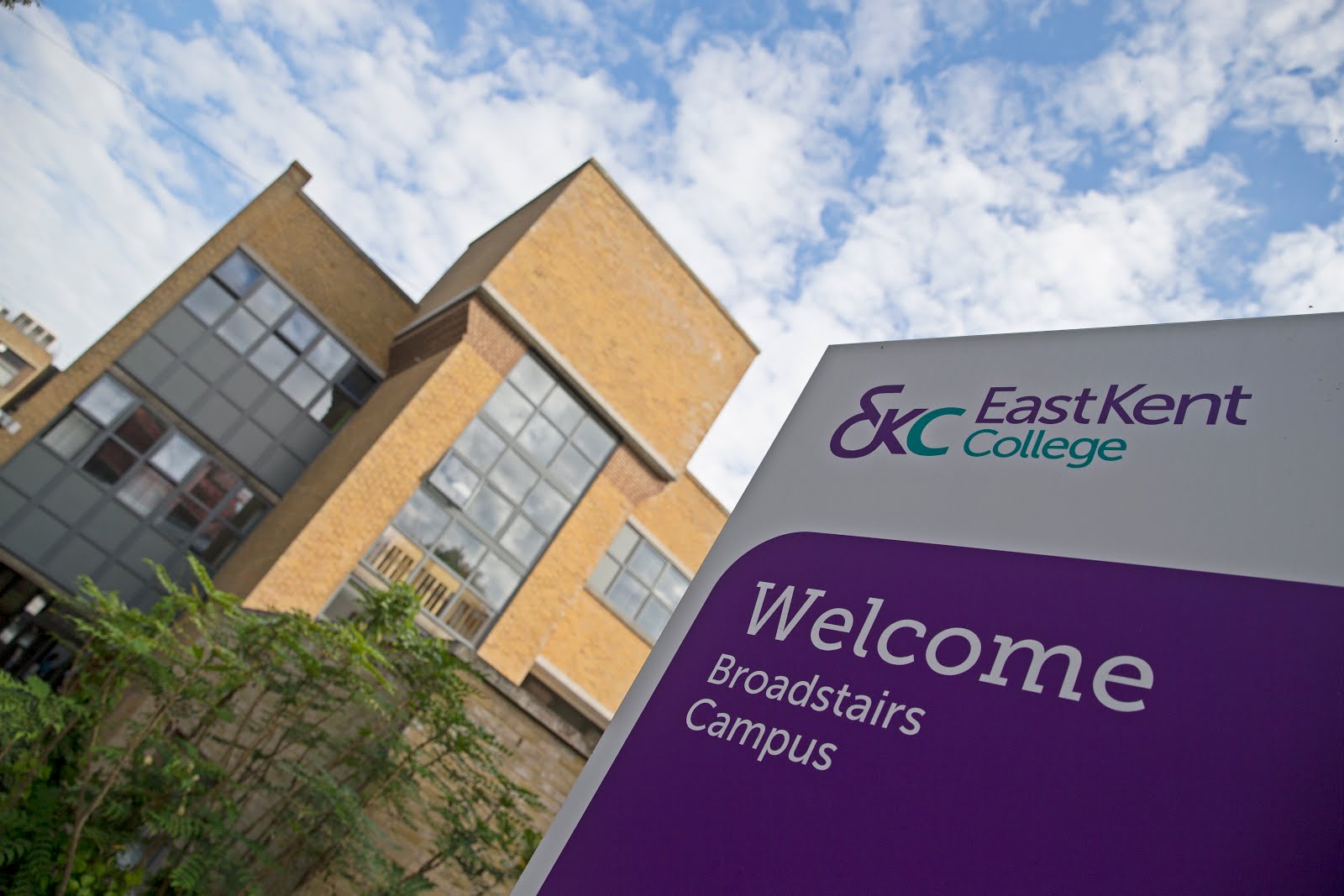
The Broadstairs Campus of East Kent College
So what has it delivered so far? It’s already brought savings, created significant efficiencies, and has helped us ensure that quality is delivered to a raised benchmark standard. It has meant that we’re able to use scale to ensure that we can provide our students – whether from Canterbury College or East Kent College – with the highest quality education, and the best possible outcomes.

And the future of this partnership is even more exciting. Why? Because as we move forward, we’ll be able to do more work in this realm, continuing to boost our students’ opportunities and outcomes while retaining vibrant and distinct further education offerings across the whole of east Kent.